Coffee Capsule MOQ: Pilot Run and Volume Pricing
Understand MOQ for private label coffee capsules, realistic pilot-run pricing, volume discounts, hidden costs, and delivery to Denmark.
Private label coffee capsules are often presented as a simple route to launching your own coffee brand. In practice, the economics depend on two factors that B2B buyers quickly run into: MOQ, meaning minimum order quantity, and the cost of a pilot run that can validate blend, extraction, and packaging before capital is tied up in a larger production. For many buyers, distributors, and brands, the question is not just what the capsules cost per unit, but what it realistically takes to get started with low risk.
At a European producer such as ATP Coffee, MOQ is not just about machine capacity. It is also about raw materials, packaging components, line setup, quality control, and logistics to markets such as Denmark. That is why the industry typically operates in the range of 5,000-50,000 capsules per SKU, while a smaller pilot or trial run is used to test whether the product works commercially and technically. If you are considering starting or expanding a range, you can also read launch your own coffee brand with private label capsules and private label vs white label coffee capsules.
What does MOQ mean for private label coffee capsules?
MOQ means minimum order quantity, in other words the smallest quantity a manufacturer accepts per order or per variant. For coffee capsules, it matters on several levels: the coffee itself, the capsule, the lid, printed labels, and outer cartons each have their own production logic and purchasing quantities.
When a manufacturer sets an MOQ, it is typically because of a combination of the following:
- changeover time on the production line
- minimum purchases of polypropylene capsules, lids, or labels
- waste during startup and calibration
- quality control and documentation
- the need for consistency in roasting, grinding, and dosing
- logistics costs for packing and shipping
For a B2B buyer, the point is simple: MOQ is not just an arbitrary threshold. It is the quantity at which the project can be produced reliably and on a commercially defensible basis.
Why does the industry typically run at 5,000-50,000 capsules?
The range of 5,000-50,000 capsules per SKU is common in Europe because it reflects the balance between flexibility and efficiency. Below around 5,000 capsules, fixed costs per unit are often too high. Above 50,000 capsules, you usually start to achieve more attractive unit pricing, but cash tied up in stock, storage requirements, and forecast risk increase in return.
There are especially four reasons why this range has become the industry’s working zone.
1. Production setup costs almost the same for small and mid-sized batches
The line still needs to be set up, tested, and approved whether you produce 5,000 or 25,000 capsules. That is why the price per capsule is relatively high for small runs.
2. Packaging components have their own minimum quantities
Lids, cartons, and labels are often ordered in larger runs than the pilot batch itself. If you want customer-specific design, component MOQ can push up the total startup cost.
3. Quality and shelf life require stable processes
Coffee capsules are sensitive to oxygen, grind size, and dosing. To ensure a consistent cup, the manufacturer must operate within parameters where the process is reproducible.
4. Logistics and distribution reward volume
Shipping to Denmark, pallet optimisation, and warehousing become more efficient at higher quantities. That does not mean bigger is always better, but it explains why the unit price falls significantly as volume increases.
A realistic MOQ is not necessarily the lowest possible quantity, but the quantity at which testing, quality, and economics work together.
ATP Coffee’s pilot run: lower MOQ to validate brand and blend
A pilot-run process at ATP Coffee is typically relevant for brands that want to validate the market before going to full scale. The purpose is not only to produce a small batch, but to use a pilot to test whether the coffee profile, capsule performance, and packaging match the target audience.
In practice, a pilot run is often used to answer these questions:
- Does the blend taste right in a Nespresso-compatible capsule?
- Do grind size and dosing deliver the desired crema and extraction?
- Does the packaging work visually and practically in retail or online?
- Is the price point realistic relative to the target channel and margin?
- Is adjustment needed before a larger purchase?
A lower MOQ in the pilot phase makes it possible to test with lower risk. This is especially relevant for new brands, chains, office suppliers, and distributors that want to gather feedback from customers or sales teams before committing to large quantities. If you want to see related solutions, go to products.
What is realistically included in the price of a pilot run?
When discussing pilot-run pricing, it is important to distinguish between unit price and total project cost. The total price consists of both variable and fixed items. Many people underestimate the fixed costs in particular because they are not visible in a simple price per capsule.
The calculation typically includes the following:
Green coffee
Raw-material price depends on origin, quality, certification, and market level. A simple espresso blend is typically priced differently from a specialty profile or certified coffee.
Roasting
The roast profile affects taste, solubility, and extraction. In a pilot, there may also be development time involved in fine-tuning the profile if the coffee does not already exist as a standard blend.
Grinding
Grind size is critical in capsules. Grinding that is too coarse can give a thin cup and weak crema. Grinding that is too fine can cause slow flow and unbalanced extraction.
Dosing
Even small differences in dose, for example 5.3 g versus 5.7 g, can affect perceived strength and cup yield.
Polypropylene capsule
The capsule body itself is a significant component cost, especially in smaller batches where purchase price is not optimised through volume.
Lid and label
Lids and any labels are often underestimated cost items. Printing, colours, finish, and separate SKUs can increase the price noticeably.
Carton packaging
Inner packs, sleeves, display cartons, or shipping cartons have their own setup and material requirements. Small runs produce a higher unit price.
Customs and shipping to Denmark
For delivery to Denmark, you need to include transport, any customs-related conditions depending on the goods flow, and administrative costs. For a producer in Europe, the setup is often simpler than importing from overseas markets, but freight is still a real cost line.
Typical price breaks by volume for coffee capsules
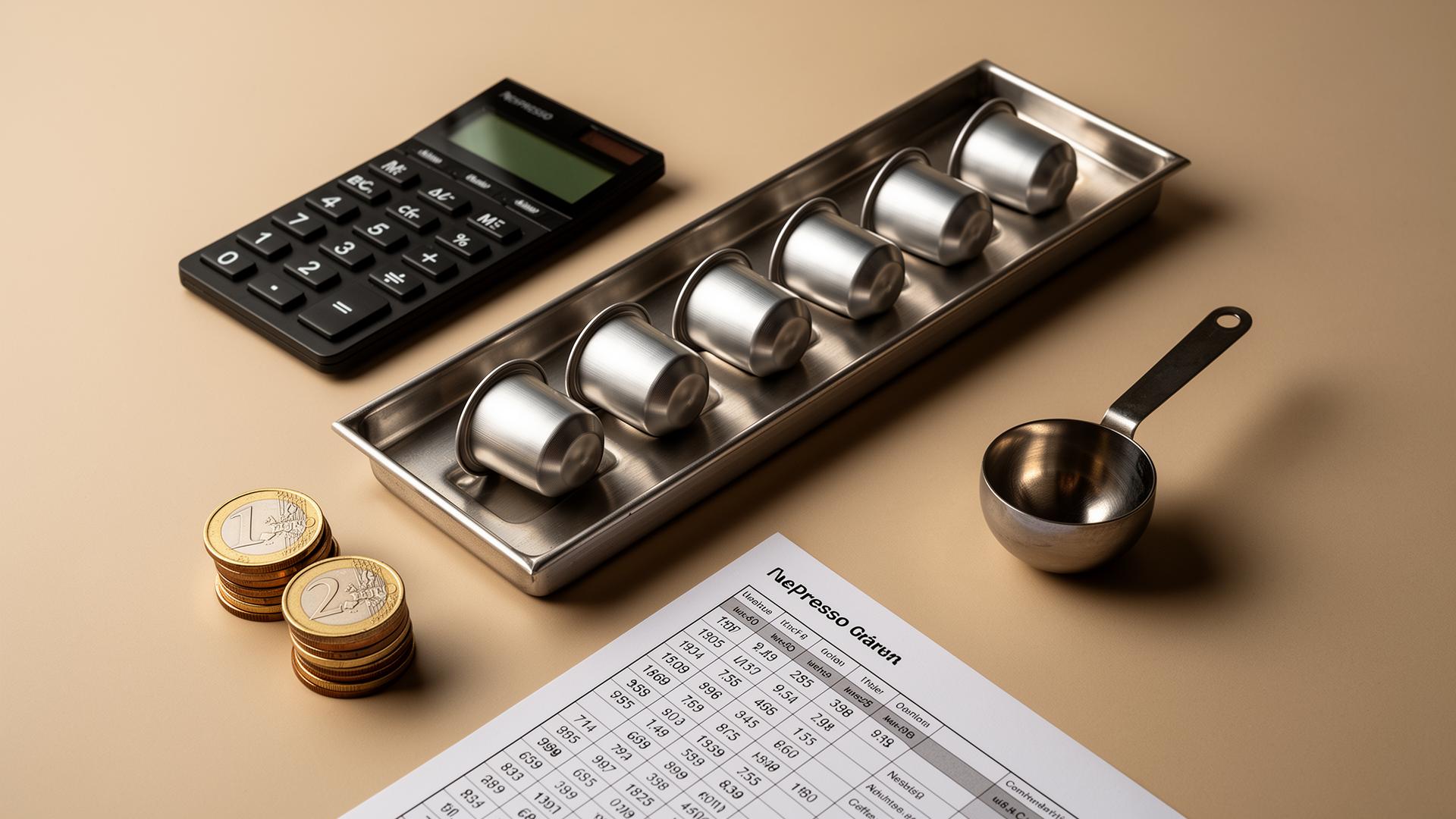
The table below shows a realistic example of how the unit price in EUR can develop with volume for a private label capsule production. The figures are indicative and depend on blend, packaging, print, certifications, and delivery terms to Denmark.
| Volume | Typical unit price (EUR) | Comment |
|---|---|---|
| 5,000 capsules | 0.28-0.36 | High share of fixed costs, suitable for a pilot |
| 10,000 capsules | 0.22-0.30 | More balanced test batch or smaller launch |
| 25,000 capsules | 0.17-0.24 | Often an attractive level for the first commercial production |
| 50,000 capsules | 0.14-0.20 | Better component purchasing and more efficient packing |
| 100,000 capsules | 0.12-0.17 | Typically stronger unit economics with stable demand |
What matters is not just chasing the lowest unit price. If 100,000 capsules deliver a good unit price but create six months of inventory exposure, the real cost can be higher than with a smaller batch that turns faster.
Hidden costs many overlook in the budget
Even experienced buyers often focus on the coffee and the capsule, but several side costs can materially affect the total economics.
Label design and artwork adaptation
If you do not already have print-ready files, there can be costs for design, proofreading, and adaptation to the manufacturer’s specifications.
MOQ on lids and other components
It is common for a manufacturer to run a smaller coffee production, while printed lids or certain cartons must be ordered in higher minimum quantities. That creates leftover packaging stock that has to be used later.
Storage rent and pallet space
If the full order is not delivered directly to the customer or your own warehouse, storage costs may arise at the manufacturer or with third-party logistics.
Sample-batch approval
Physical samples, courier shipping, extra adjustment rounds, and internal tasting-panel testing all cost time and money, even if they do not always appear as a separate line in the first quotation.
Compliance and specification work
Ingredient specifications, labelling checks, EAN setup, and documentation for retail chains can also be a real project cost.
A useful checklist before approving the quotation is:
- Is the price inclusive or exclusive of printed lids and labels?
- Is carton packaging included in the unit price?
- Is freight to Denmark included or listed separately?
- Is there a startup fee on the first production?
- What is the MOQ per SKU and per packaging component?
- Are sample approval and any corrections included?
- What payment terms apply to a pilot versus full production?
How a small pilot is used to fine-tune crema and extraction
One of the most overlooked reasons to run a pilot is technical learning. Coffee that tastes right in cupping or as whole beans does not necessarily perform optimally in capsule format. This is especially true for Nespresso-compatible capsule production, where flow, pressure, and capsule geometry play a major role.
ATP Coffee can use a small pilot to adjust several parameters before scaling:
Roast profile
Small changes in development time and end temperature can affect solubility, bitterness, and aroma in the capsule.
Grind curve
Not only average particle size, but the entire distribution affects flow time and cup quality.
Dose per capsule
A change of a few tenths of a gram can be decisive for balance, body, and crema.
Filling and sealing
Seal quality affects oxygen barrier and shelf life. It is important to test how the capsule performs after production and not only immediately after packing.
Sensory validation
The pilot batch makes it possible to taste in relevant machines and across different water profiles and brewing habits.
That means the pilot is not just a cost. It is a tool to reduce the risk of an expensive mistake in full production.
Shipping to Denmark: what should you expect?
For Danish brands and distributors, lead time and freight cost are a central part of the decision. With production in Europe, the shipping flow is normally more predictable than sourcing from distant markets. That can make planning, reordering, and communication easier.
When shipping to Denmark, you should normally clarify:
- delivery term, for example EXW, FCA, or DDP
- whether the price includes or excludes delivery in Denmark
- transit time from production to Danish address
- pallet configuration and minimum per shipment
- handling of customs or other border-related formalities
- whether partial deliveries are possible
For smaller pilot shipments, the freight cost per unit can be relatively high because the shipment does not fill a pallet efficiently. With larger batches, freight typically accounts for a smaller share of the total price.
Payment terms for pilot and full production
Payment terms on private label projects usually reflect the manufacturer’s risk and capital commitment. For a first pilot run, it is common to see more conservative terms than in an ongoing partnership.
Typical models can include:
- prepayment for the first pilot or a new customer
- 50/50, where part is paid at order confirmation and the remainder before dispatch
- partial prepayment for specially purchased packaging components
- credit terms only after a documented cooperation history
For the buyer, it is important to clarify when an order becomes binding, what happens if changes are made after artwork approval, and whether specially manufactured components can be cancelled. Especially with custom lids, labels, and cartons, the cost is often not reversible once production has started.
How to assess whether the pilot run is worth the money
The right assessment is rarely based on unit price alone. A good pilot run should be seen as a decision tool. If the pilot batch makes it possible to adjust the blend, validate the selling price, test customer response, and avoid a mistaken purchase on a large scale, it is often cheaper than the alternative.
So do not ask only: What does a pilot run cost? Also ask:
- What learning do we get from the batch?
- Can we test several sales channels with the same production?
- Is the packaging scalable to the next order?
- Which parameters can still be adjusted after the pilot?
- What would a mistake in 25,000 or 50,000 capsules cost us?
For many brands, the best path is a small, controlled pilot followed by a scaled order once data and feedback confirm product-market fit.
Next steps
If you want to understand what MOQ and pilot-run pricing concretely mean for your brand, the most effective step is to get a quotation based on your desired blend, capsule type, packaging, and delivery address in Denmark. That lets you see the difference between pilot and full production, including components, freight, and payment terms.
The next natural step is to clarify your target volume, whether you want standard or custom packaging, and whether the pilot batch is mainly for sales validation or technical fine-tuning. Once those parameters are clear, it becomes much easier to assess the real price per capsule and the total capital commitment.
If you want to take the discussion further, you can book a pilot run and clarify MOQ, pricing level, delivery to Denmark, and the best route from pilot to full production.
Frequently asked questions
- What is a typical MOQ for private label coffee capsules?
- A typical MOQ is often between 5,000 and 50,000 capsules per SKU, depending on the manufacturer, capsule type, blend, and packaging. With custom packaging, the minimum quantity may also be driven by lids, labels, or cartons rather than the coffee production itself. A pilot can sometimes be carried out at lower or more flexible quantities, but the unit price is usually higher because startup, quality control, and component costs are spread across fewer units.
- What does a pilot run realistically cost?
- That depends on blend, dose, capsule material, print, packaging, and freight to Denmark. In practice, you need to look at both unit price and fixed project costs. A small pilot can have a high price per capsule because startup, testing, and component MOQ account for a relatively large share. That is why it is important to have the quotation broken down into coffee, capsules, lids, packaging, freight, and any startup fees so the economics can be assessed correctly.
- Is freight to Denmark normally included in the quotation?
- Not always. Some quotations are given ex works or FCA, while others can be prepared with delivery to a Danish address. You should therefore always have the exact delivery term, transit time, and whether pallet freight, administrative costs, and any customs-related conditions are included confirmed. For small pilot shipments, freight can have a relatively large effect on the total price, while larger productions usually provide more efficient logistics economics.
- Can blend and extraction be adjusted after a pilot batch?
- Yes, that is one of the main reasons to run a pilot. A smaller batch is often used to test crema, flow time, aroma, and balance in relevant machines. Based on the results, the manufacturer can adjust roast profile, grind size, dose, or individual capsule components before a larger production run. That reduces the risk of ordering a large quantity that does not perform as desired in the cup.
- What hidden costs should I ask about?
- You should especially ask about label design, artwork adaptation, MOQ on printed lids, storage fees, sample shipments, approval rounds, and any startup charges. In addition, documentation, labelling control, and special packaging can affect the total price more than many expect. A good quotation should make it clear which costs are one-off expenses, which are variable per capsule, and which arise only at reorder or during storage.
- What payment terms are normal for a first order?
- For a first order or pilot, prepayment or partial prepayment is very common, especially if specially printed components are being purchased for the project. A model with 50% at order confirmation and 50% before dispatch is often seen. More flexible credit terms usually become relevant only once the cooperation is established and there is a history of repeat orders. Always have the payment schedule, cancellation terms, and ownership of special components confirmed in writing.
Ready to talk specs?
Tell us your blend, format and target volume — we'll come back with a pilot quote in 24 hours.