Private Label vs White Label Coffee Capsules: What’s the Difference?
Understand the difference between private label and white label coffee capsules: recipe, exclusivity, MOQ, price, and margin for your coffee brand.
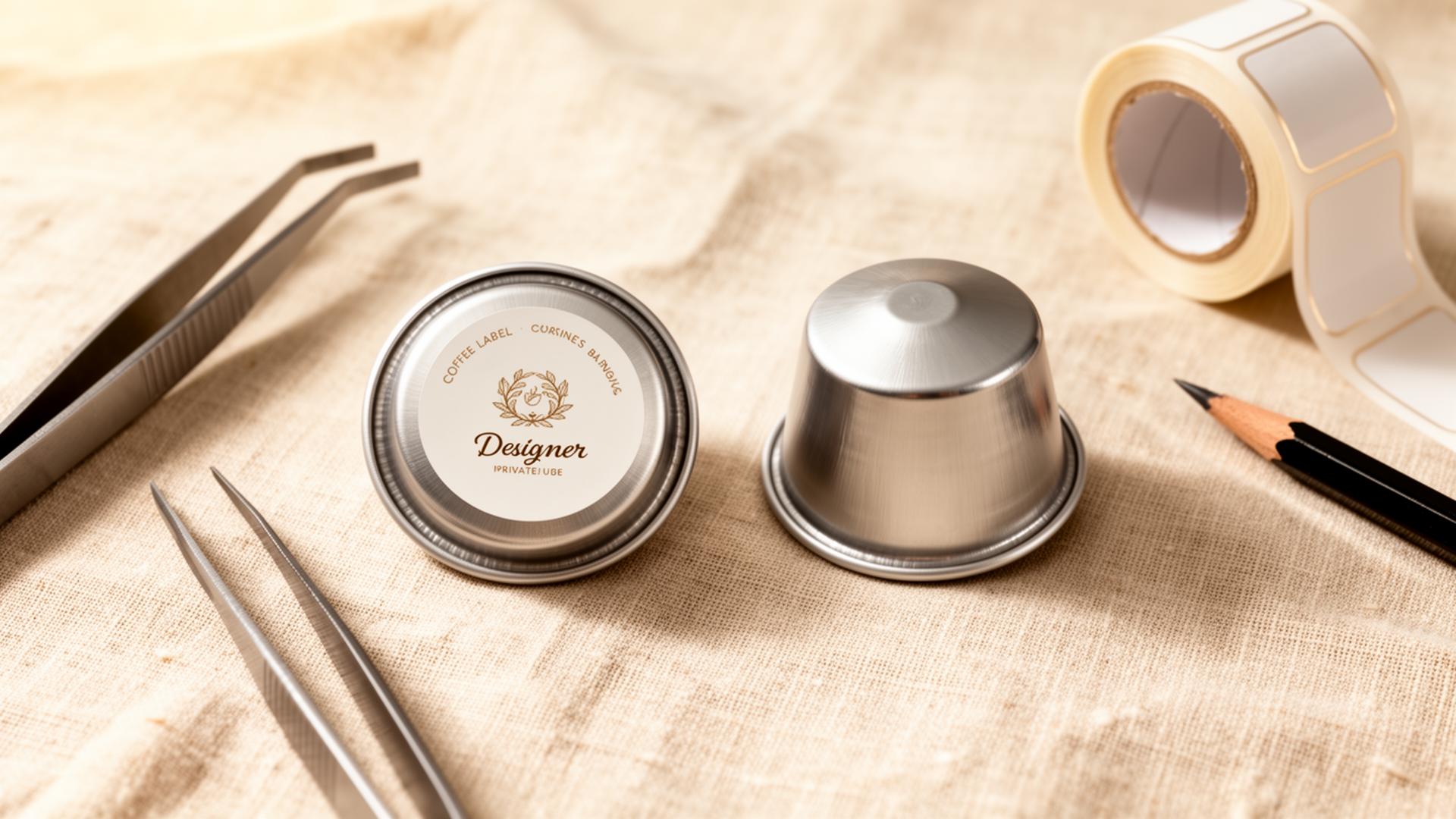
When you want to launch coffee capsules under your own brand, you quickly encounter two terms that are often mixed up: white label and private label. They sound related, but in practice they have major implications for your product strategy, your margins, your time to market, and not least your ownership of taste and positioning. For many B2B buyers, the difference is not just semantics. It determines whether you are building a brand with a unique flavour profile or choosing a faster, more standardised route to market.
In the coffee capsule industry, the terms are not always used consistently. That is why it is important to establish the terminology, especially if you are comparing suppliers. At ATP, we work with both models, but they solve different tasks. White label is often the right solution for a quick market test or a low-risk setup. Private label is more often the right choice when you want to own your taste, strengthen your brand, and build a more durable business. If you are early in the process, you can also read launch your own coffee brand with private label capsules for a broader overview.
Definitions: What do white label and private label coffee capsules mean?
The most useful way to distinguish between the two models is to look at three things: standardisation, ownership, and exclusivity.
White label coffee capsules are typically an existing standard product. The manufacturer has already developed one or more blends that several customers can buy. You put your own name, design, and label on the product, but the content itself is not, as a rule, developed specifically for your brand.
Private label coffee capsules, by contrast, are developed for your brand. It may be an adjusted version of an existing profile or a completely new recipe. The point is that the product is tied to your brand strategy, your desired flavour direction, and often also a higher degree of exclusivity.
In practice, this means:
- White label = standard blend, your label
- Private label = brand-adapted recipe, often with higher exclusivity
- White label = faster and cheaper startup
- Private label = greater control and stronger differentiation
The most important difference is not the packaging, but who actually owns the product’s identity: the supplier or the brand.
This is also where many people misunderstand the market. Some suppliers use “private label” for anything with the customer’s logo on it. But if the coffee is a shared standard blend that other customers can also buy, the model is in reality closer to white label.
Ownership of recipe and IP: do you own your blend formula?
If you want to build a long-term coffee brand, ownership is a central question. Not necessarily in the legal patent sense, but in the commercial sense: can others buy the same taste? Can your supplier sell nearly identical capsules to a competitor? Can you move production without losing your entire product identity?
With white label, the answer is often that the supplier owns the product foundation. You buy access to an existing blend and get permission to sell it under your brand. That can be efficient, but your differentiation lies primarily in design, distribution, and marketing.
With private label, you should clarify the following in the cooperation:
- whether the recipe is developed specifically for your brand
- whether the blend is exclusive to you in certain markets
- whether the manufacturer may sell the same or a similar profile to others
- whether documentation of composition and profile is contractually described
- what happens if you change supplier
IP in coffee is often about contractual exclusivity and commercial rights, not classic intellectual property alone. A blend formula may be difficult to “own” in the abstract, but it can still be reserved for your brand through agreement terms.
For brands focused on repeat purchase and strong recognition, this is crucial. If customers come back because of the taste, the taste should not be something a competitor can easily buy from the same catalogue.
White label coffee capsules: when does it make sense?
White label is not a bad solution. On the contrary, it can be the most rational model in a number of situations, especially when speed and low risk matter more than unique product development.
White label often makes sense when you:
- want to test demand quickly
- have a limited startup budget
- want to avoid a longer development process
- sell in a price-sensitive segment
- see coffee as an add-on product rather than a core product
- have a campaign, gift box, or seasonal launch with a limited lifespan
This applies, for example, to retail chains, gift companies, office suppliers, or hospitality operators that want a capsule solution without building a deep flavour universe.
The advantage is simple: a shorter path from idea to product. You select from approved profiles, approve the packaging, and go into production. In some cases, that is the right low-stakes strategy because you deliberately want to learn about the market before investing more.
But white label has limitations. If others can buy the same product, it becomes harder to charge a premium price based on the coffee itself. In that case, value must come from brand experience, distribution, community, or visual identity.
Private label coffee capsules: when is it worth paying extra?
Private label becomes interesting when coffee is not just a product, but a central part of your brand promise. If you want customers to recognise your taste, return, and accept a higher price, product differentiation becomes much more valuable.
It is typically worth paying extra for private label when you:
Want to position yourself clearly
A premium brand rarely benefits from selling a generic standard blend if the ambition is to stand for something distinctive. Your own profile makes it easier to define your brand through tasting notes, intensity, origin, and roast style.
Expect repeat purchases
When the business is built on subscription-like behaviour or recurring purchases, product consistency and recognition become very important. A unique profile strengthens the likelihood of loyalty.
Want to work with higher margins
If you can support a premium price with a more distinctive coffee experience, better raw-material choices, or a sharper brand story, private label can improve your margin structure, even if the purchase price is higher.
Want to protect your brand over the long term
The more you invest in branding, content, advertising, and distribution, the more problematic it is if the product behind the brand is not especially protected. Private label reduces the risk that your brand value rests on an interchangeable standard product.
For many serious brands, the extra investment is therefore not just a cost, but a way to increase the total value of the business.
Practical differences in MOQ, development time, and flexibility
One of the most concrete differences between white label and private label is minimum order size, development process, and production setup. Here it is important to have realistic expectations.
White label can often start at a lower level because the product already exists. In many cases, the entry point is around 1,000-2,000 capsules depending on capsule type, packaging format, and print solution.
Private label more often requires higher volume. When a more customer-specific solution has to be developed, tested, documented, and produced, MOQ typically starts at 5,000 capsules or more. For some concepts it can be significantly higher, especially with complex packaging or several SKUs.
If you want to understand more concretely how volume affects economics, also read coffee capsule MOQ: pilot run and volume pricing.
Typical differences in practice
| Parameter | White label coffee capsules | Private label coffee capsules |
|---|---|---|
| Product basis | Standard blend from the manufacturer | Blend developed for your brand |
| Branding | Own label and design | Own label, design, and product profile |
| Exclusivity | Usually low or none | Often possible, depends on the agreement |
| Ownership of taste | Manufacturer-driven | More customer-driven |
| MOQ | Often 1,000-2,000 capsules | Often 5,000+ capsules |
| Development time | Short | Longer |
| Purchase price | Lower | Higher |
| Potential for premium pricing | Limited to moderate | Moderate to high |
| Suitable for market testing | Yes | Less obvious |
| Suitable for long-term brand building | Limited | Yes |
The table simplifies reality, but it illustrates the basic logic: the more unique a solution you want, the more it requires in volume, time, and investment.
Price level and margin implications: cheaper is not always better
It is easy to focus narrowly on the unit price per capsule. But the most relevant metric for a brand is often gross margin plus repeat rate plus price position. Here, private label can in many cases be more attractive, even if the purchase price is higher.
White label and margin
White label often has a lower barrier to entry:
- lower development cost
- lower MOQ
- faster launch
- less capital tied up in the first batch
That is positive for cash flow and risk management. But if the product is easy to compare with others, you may face more price pressure. Your margin becomes more vulnerable, especially in segments where customers do not perceive a clear difference in taste and quality.
Private label and margin
Private label can have:
- higher development cost
- higher MOQ
- higher purchase price per capsule
- longer time to market
In return, the right flavour profile and stronger brand story can make it possible to:
- charge a higher selling price
- reduce direct price comparability
- increase customer loyalty
- raise average order value
That does not mean private label automatically produces better economics. But it creates better conditions for building economics that do not rely only on the lowest price.
A simple rule of thumb is: if coffee is central to your identity and contribution margin, you should not assess the model on purchase price alone.
Branding and exclusivity: how much should your brand be able to own?
Many companies overestimate how much branding alone can carry if the underlying product is generic. Attractive design can create the first purchase. A strong taste experience and clear product recognition often create the second and third purchase.
With white label, the branding weight lies in:
- name
- packaging
- visual identity
- channel strategy
- customer service and content
With private label, branding can also be anchored in the product itself:
- your own flavour direction
- a specific intensity level
- selected origins or profiles
- a consistent sensory experience that customers associate with your brand
Exclusivity is especially important if you operate in a competitive market. If the same or nearly the same coffee can end up with several brands, it becomes harder to defend a unique position. That is why exclusivity should not be a vague expectation, but an explicit point in the cooperation.
Checklist before choosing a model
- Is coffee a core product or a side product in your business?
- Do you need to test the market quickly, or are you building long-term brand value?
- Do you expect a high repeat-purchase frequency?
- Do you need exclusivity in taste or market?
- Can you support a higher MOQ to get better differentiation?
- Is your target audience price-driven or quality-driven?
- Do you need to justify a premium price credibly?
If you answer yes to several of the later questions, that often points towards private label.
Common misunderstandings about white label and private label
There are several recurring misunderstandings in the market that can lead to the wrong decision.
“Private label just means my logo on the box”
No. That only describes branding in itself, not necessarily product development. If the content is a standard blend, the solution is often effectively white-label-like.
“White label is only for small businesses”
That is not correct either. Large companies also use white label for test launches, campaigns, and new channels. It is a strategic model, not only a beginner model.
“Private label is always completely unique and fully owned by the customer”
Not automatically. It depends on the contract, the development process, and the degree of exclusivity. You need to ask specifically about rights and permitted use.
“Lower MOQ always means a better business”
Not necessarily. Lower MOQ reduces short-term risk, but it can also lead to a product with less differentiation and greater price sensitivity. The best model depends on your strategy.
“If the taste is good, ownership does not matter”
Only partly. The taste may be good, but if a competitor can buy something very similar, you lose part of your competitive advantage.
What ATP offers: both models, but with a focus on long-term brand value
At ATP, we work with both white label and private label coffee capsules because customers have different goals, budgets, and time horizons. For some brands, white label is the most sensible way to get started quickly. This is especially true if you want to validate demand, test a sales concept, or launch without a heavy development process.
But for brands that want to build something lasting, we often recommend private label. The reason is simple: when you want to own your taste, protect your position, and create a more robust premium brand, a customer-specific solution is usually stronger than a standard blend with new design.
That does not mean everyone should start with maximum complexity. In some cases, the right route is a stepwise model:
- Start with a simple setup to validate the market.
- Collect data on target audience, taste preferences, and repeat purchase.
- Move to private label once the case is proven.
Other brands should go directly to private label from day one, especially if they already have distribution, clear positioning, or ambitions for premium pricing. If you want to see which solutions exist, you can read more about coffee capsule solutions for brands.
When capsules are described in relation to machine compatibility, they are referred to as Nespresso-compatible in line with third-party trademark practice. That is important for correct and precise communication in the market.
Next steps
The choice between white label and private label coffee capsules should not be made based on buzzwords, but on your business model. If you want to test quickly with lower investment and limited risk, white label is often an effective solution. If you want to build a stronger brand with control over taste, greater differentiation, and better potential for premium positioning, private label is usually the better route.
What matters is clarity on definitions, MOQ, price structure, exclusivity, and rights before you compare quotations. Otherwise, you risk comparing two models that look similar on the surface but create very different business outcomes.
If you want to clarify which model fits your brand and what a realistic test or development process might look like, you can book a pilot run.
Frequently asked questions
- What is the concrete difference between white label and private label coffee capsules?
- The concrete difference lies in the product’s origin and the degree of customisation. White label usually means you choose an existing standard blend from the manufacturer and sell it under your own brand. Private label means the coffee is developed or adapted specifically for your brand, often with the option of exclusivity. As a result, white label is typically faster and cheaper to launch, while private label gives more control over taste, positioning, and long-term differentiation.
- What is the typical MOQ for white label and private label coffee capsules?
- White label can often start lower, typically around 1,000-2,000 capsules, because the product has already been developed and is ready for production. Private label more often starts at 5,000 capsules or more because there are more steps in development, testing, approval, and production setup. The exact MOQ, however, depends on capsule type, packaging, number of SKUs, and how much customisation you want. MOQ should therefore always be assessed together with price, flexibility, and your expected sales pace.
- Is private label always more expensive than white label?
- Yes, in most cases private label is more expensive on the buying side because there is more development work, more coordination, and often higher volume requirements. But that does not necessarily mean the total economics are worse. If private label makes it possible to charge a higher selling price, create better repeat purchase, and strengthen your brand position, the solution can be more profitable over time. The right choice therefore depends not only on unit price, but on your margin model and brand strategy.
- Can I own my own blend formula in a private label setup?
- You can often obtain a high degree of commercial control, but it depends on the agreement with the manufacturer. In practice, ownership often comes down to exclusivity, rights of use, documentation, and restrictions on whether the manufacturer may sell the same or a similar blend to others. That is why it is important to have rights and exclusivity clearly written into the cooperation. Ask specifically whether the recipe is developed for your brand and what happens if the cooperation ends or production moves to another supplier.
- When should I choose white label rather than private label?
- White label is often the right choice if you want to test the market quickly, keep investment down, or launch coffee as a secondary product without a long development timeline. It is especially relevant for campaigns, gift concepts, new sales channels, or early phases where you first want to validate demand. If, by contrast, you expect a high repeat-purchase rate, want to charge a premium price, and see coffee as a central part of your brand, you should usually assess private label more seriously.
- Does ATP offer both white label and private label coffee capsules?
- Yes, ATP offers both models. White label often suits brands that want to enter the market quickly with lower complexity and less startup investment. Private label, by contrast, is typically best for brands that want to build their own flavour profile and create stronger differentiation. ATP often recommends private label to businesses that want to own their taste and use the product actively in their positioning. The right solution depends on your brand, your goals, and your expected volume.
Ready to talk specs?
Tell us your blend, format and target volume — we'll come back with a pilot quote in 24 hours.