Nespresso-Compatible Capsules: OL vs Vertuo for Private Label
Learn the difference between OL and Vertuo Nespresso-compatible capsules, from technology and patents to materials and private label choices.
When a coffee brand needs to choose a capsule platform for private label, the question of OL or Vertuo is often the first strategic decision. It is not only a matter of taste or cup size, but also of technology, machine compatibility, material choice, patent position, and commercial risk. For most European brands looking to launch or expand a capsule programme, the difference between the two systems is so large that in practice the choice often falls in favour of OL.
In short, OL, meaning Original Line, is the mature and open platform many people associate with classic espresso capsules. Vertuo, by contrast, is a newer and more closed system with a different brewing method, different capsule geometries, and proprietary control via a barcode on the capsule. If you work with private label, where flexibility, availability, and scalability matter, it is therefore important to understand the technical and commercial differences in detail.
This guide reviews the history, technology, capsule materials, machine fit, patent picture in the EU, and the practical recommendation for private label brands. Along the way, we also explain why many brands choose polypropylene capsules and why OL is in most cases the most realistic route to market. If you first want to understand the business model behind capsule production itself, you can read the difference between private label and white label coffee capsules. You can also see ATP Coffee’s range of capsule solutions.
Short history: from Original Line in 1986 to Vertuo in 2014
Original Line was launched in 1986 and quickly became the reference many people associate with portion-based espresso at home and in smaller offices. The system was built around a relatively compact capsule and a brewing logic focused on espresso and lungo. Over time, adoption grew significantly, creating a large aftermarket for compatible capsules, especially once patent protection in Europe began to lose strength after 2012.
Vertuo came later, launched in 2014 as an attempt to expand the capsule experience to larger cup formats and a different type of consumption. Where OL was strongly linked to espresso culture, Vertuo was developed to support larger servings such as mug and carafe. That made the system attractive to consumers who wanted more filter-like volume from a capsule machine, but it also meant a completely different technical architecture.
Historically, the difference matters because OL today is a mature ecosystem with many actors in the value chain: machines, fillers, capsule manufacturers, foils, logistics partners, and private label producers. Vertuo, by contrast, is still more tightly controlled and more dependent on the original system specification. For a brand, platform maturity often matters more than the machine technology itself, because it affects price, development speed, and room for differentiation.
Technical difference between OL and Vertuo
The most important technical difference lies in the extraction principle itself. OL is, in practice, a pressure-based system, often referred to as 19 bar in the machine’s pump architecture. What matters is not only the figure in the marketing, but that brewing takes place by forcing hot water through the ground coffee in the capsule under high pressure. This produces the profile many associate with classic espresso: relatively concentrated liquid, clear intensity, and a crema-like surface.
Vertuo, by contrast, uses centrifugal extraction. Here the capsule rotates at high speed while water is introduced, and extraction is controlled through the combination of rotation, water supply, and the machine’s reading of a barcode on the capsule. The barcode tells the machine how to brew that specific capsule, for example water quantity, rotation pattern, and extraction profile.
This leads to some clear consequences:
- OL requires precise control of grind size, fill weight, compaction, oxygen barrier, and foil sealing to perform reliably under pressure.
- Vertuo requires not only the correct coffee content, but also capsule geometry, mechanical stability under rotation, and correct coding so the machine can read the capsule and select the brewing programme.
- OL compatibility depends to a large extent on physical fit and flow under pressure.
- Vertuo compatibility depends on both physical fit and proprietary system control.
For private label, it is rarely the pure flavour profile alone that decides the platform. Technical openness and the ability to achieve stable compatibility are often more business-critical than the brewing method itself.
For brands, this means OL is far easier to industrialise across partners. There is more experience, more standardised production environments, and a broader base of documented knowledge about how capsules behave in the many OL machines on the market. Vertuo places greater demands on system-specific integration, which in practice limits the options for independent private label launches.
Volume and cup sizes: espresso focus versus broader serving formats
Another central distinction between OL and Vertuo is the cup sizes the systems are typically designed for.
OL is fundamentally built for the classic, smaller coffee formats:
- ristretto
- espresso
- lungo
That makes OL especially suitable for brands that want to work with espresso-oriented blends, single-origin profiles, or darker roasts where concentration and aromatic intensity matter. When developing private label on OL, you can position the range very precisely around intensity, acidity, roast profile, and sensory style within well-known coffee formats.
Vertuo covers broader cup volumes, typically:
- espresso
- gran lungo
- mug
- alto
- carafe
This opens up a different consumption pattern. It is not only about a quick espresso shot, but about larger servings that in some cases come closer to filter coffee in volume. For some markets and consumer groups, that can be attractive, but for a private label brand it also makes assortment strategy more complex. You need not only develop the coffee sensorially, but also decide which cup sizes the portfolio should be built around and how they match the installed machine base.
In Europe, independent private label activity remains strongest on the OL side, precisely because the classic espresso use case is well defined and many consumers already know the format. For brands, that means faster onboarding and less need to explain a new system.
Capsule geometry and materials: polypropylene versus plastic and hybrid solutions
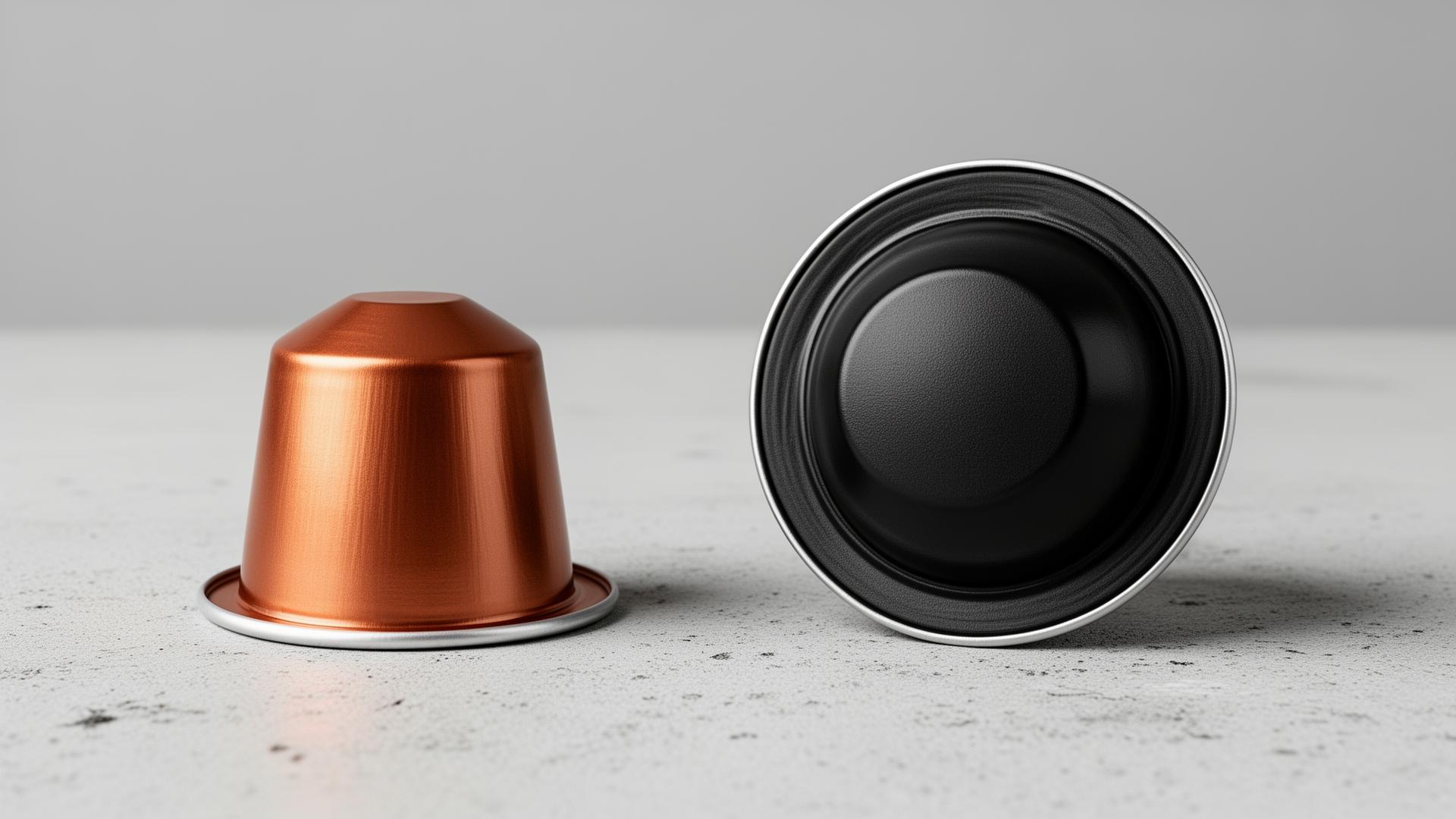
OL and Vertuo capsules differ significantly in form factor. The OL capsule is smaller and designed to work in a pressure-based chamber. That places high demands on dimensional stability, rim design, top foil, and the material’s ability to protect the coffee from oxygen, light, and moisture.
In private label, polypropylene is often the preferred material for OL-compatible capsules. This is due to several factors:
- high barrier against oxygen and moisture
- good dimensional stability
- well-known performance in pressure-based systems
- premium perception among many consumers
ATP produces OL-compatible capsules in polypropylene, which is relevant for brands that want a solution with high product protection and a format that is well established in the European market.
Vertuo capsules have a different geometry and are often seen in solutions where plastic and polypropylene are used in combination, depending on the construction. The larger capsule, the rotating extraction, and the machine-controlled reading mean that material choice is not only about barrier properties, but also about mechanical behaviour during rotation and reliable machine reading.
In practice, for private label the material question is less a matter of theory and more a matter of access to a robust industrial chain. Here OL has a clear advantage because many suppliers can already document stable production, sealing quality, and shelf life in polypropylene solutions.
Which machines do the capsules fit?
Machine compatibility is the point where many B2B buyers are surprised by how little overlap there actually is between the systems. An OL-compatible capsule fits machines designed for the Original Line format. A Vertuo capsule fits Vertuo machines. The two systems are not cross-compatible.
That sounds obvious, but it has major commercial consequences. When a brand chooses a capsule platform, it is simultaneously choosing which installed machine base it wants to sell into.
OL machines
OL-compatible capsules target the large base of machines developed for the Original Line format. This typically gives:
- broad market access
- strong consumer understanding
- easier distribution in retail, online, and B2B
- more sourcing options
Vertuo machines
Vertuo capsules are tied to Vertuo machines and the logic built into barcode reading and centrifugal extraction. That means:
- a more closed ecosystem
- fewer realistic compatible solutions outside the system owner
- greater dependence on proprietary technology
For a private label brand, it is critical to assess how large the relevant machine base is in the markets you want to enter. If the goal is to reach volume quickly in Europe, OL usually offers the most direct route to existing demand.
The patent situation in the EU: why OL is open while Vertuo remains proprietary
The patent picture is a key explanation for why OL and Vertuo are so different commercially. After core rights around the OL system in the EU expired after 2012, the market became significantly more open to compatible capsules. This created the basis for third-party manufacturers, private label solutions, and greater competition on price, quality, and materials.
That does not mean everything about OL is free of technical challenges. Compatibility still needs to be developed and validated carefully. But legal and industrial access to the market is far more realistic than in a closed system.
Vertuo, by contrast, remains closely connected to proprietary elements, especially the machine’s reading of the barcode on the capsule and the overall control of the brewing process. That is why genuine Vertuo-compatible capsules are rare outside the system owner itself. Even where attempts at compatibility exist, availability, consistency, and scalability are often much less certain than on the OL side.
For B2B buyers, the conclusion is simple: if you want a platform where private label can be developed, produced, and distributed robustly in the EU, OL is by far the more open solution. Vertuo may be interesting to understand as a market trend, but it is rarely a practical first choice for an independent brand.
Comparison: OL versus Vertuo for private label brands
| Parameter | OL (Original Line) | Vertuo |
|---|---|---|
| Launch | 1986 | 2014 |
| Brewing method | Pressure-based, often referred to as 19 bar | Centrifugal extraction |
| Control | Mechanical and flow-based compatibility | Barcode on the capsule controls brewing |
| Typical cup sizes | Ristretto, espresso, lungo | Espresso, gran lungo, mug, alto, carafe |
| Capsule geometry | Compact espresso format | Larger, system-specific geometry |
| Materials in the market | Often polypropylene | Often plastic/polypropylene or system-specific solutions |
| Machine compatibility | OL machines | Vertuo machines |
| Patent and market access in the EU | Relatively open after 2012 | Still more proprietary |
| Suitability for private label | Very high | Limited |
| Practical recommendation | Standard choice for most brands | Only relevant in special cases |
The table shows the underlying reality: OL is structurally simpler to work with for an independent brand, while Vertuo is tied to a more closed and controlled ecosystem.
Commercial recommendation: why private label brands should almost always choose OL
When you combine technology, machine base, patent position, sourcing, and time to market, the commercial recommendation is clear. For private label brands, OL is almost always the right choice.
There are several reasons for this.
1. Faster and more realistic launch
A brand can reach the market much faster with OL-compatible capsules because production infrastructure and know-how are already well established. This reduces development risk and shortens the path from concept to shelf.
2. Better access to compatible production
There are more experienced manufacturers, more material options, and more mature quality control on OL. That makes it easier to ensure consistency at scale.
3. Greater freedom in assortment development
OL provides a clear and familiar framework for espresso, lungo, and related formats. That makes assortment management simpler, both sensorially and commercially.
4. Lower system dependence
A private label brand should usually avoid unnecessarily high dependence on proprietary systems. OL provides more control over sourcing, product development, and long-term portfolio planning.
5. Better fit for European retail and online channels
In many European markets, demand for OL-compatible capsules is well established and easier to activate in retail, subscription, and campaign channels.
A practical decision checklist for brands may look like this:
- Choose OL if the goal is rapid market access in the EU.
- Choose OL if you want to work with private label in scalable production.
- Choose OL if compatibility and supply security matter more than a niche system’s special features.
- Be cautious with Vertuo if you do not have a very specific commercial case and access to a documented system-specific solution.
- Prioritise polypropylene if barrier performance, premium perception, and product stability are central criteria.
ATP’s approach: OL-compatible polypropylene capsules for European brands
For brands that want to build a strong and scalable capsule programme, it is crucial to choose a partner that understands both production details and market requirements. ATP produces OL-compatible capsules in polypropylene and works with solutions relevant to European private label customers.
That matters because success with capsules is not only about filling coffee into a capsule. It is about tolerances, fill weight, grind profile, oxygen control, foil sealing, logistics stability, and consistent performance in the market’s machines. For a private label buyer, operational robustness is often what determines whether a product can scale without quality issues.
When you choose OL in polypropylene, you get a combination of a familiar platform and a material widely accepted in the premium segment. For brands that want to position themselves with clear quality and high compatibility, it is a rational and proven solution.
Next steps
If you are facing the choice between OL and Vertuo for a private label programme, the practical conclusion is simple in most cases: start with OL. It is the most mature, open, and commercially robust platform in the EU, especially when the goal is to build a brand with a realistic time to market and stable supply.
The next step is to clarify your assortment, target markets, price point, and requirements for material and compatibility. From there, you can assess which capsules and production setups best fit your brand. If you want to discuss the options for OL-compatible polypropylene capsules, you can book a pilot run.
Frequently asked questions
- What is the most important difference between OL and Vertuo for a private label brand?
- The key difference is that OL is a much more open and mature platform in the EU, while Vertuo is still closely tied to proprietary technology. OL is built on a classic pressure-based system and has a large ecosystem of compatible manufacturers and machines. Vertuo uses centrifugal extraction and a barcode on the capsule, which makes compatibility more complex. For a private label brand, that means OL typically offers lower development risk, faster launch, and better access to scalable production.
- Are genuine Vertuo-compatible capsules realistic for independent brands?
- In practice, they are far rarer and more difficult to work with than OL-compatible capsules. The reason is that the Vertuo system remains closely linked to proprietary elements, especially the barcode and the machine’s brewing control. Although some solutions may exist in the market, they are often less widespread and more uncertain in a scalable B2B context. That is why most independent brands choose OL when they want a stable and commercially realistic private label solution.
- What cup sizes do OL and Vertuo typically support?
- OL is primarily associated with ristretto, espresso, and lungo, meaning the classic smaller coffee formats. That makes the system well suited to brands that want to focus on the espresso experience. Vertuo typically supports espresso, gran lungo, mug, alto, and carafe, meaning larger serving sizes. That can be attractive in certain usage situations, but it also makes assortment strategy more complex. For many private label brands, OL is easier to position because the format is familiar and demand in Europe is clear.
- Why do many manufacturers choose polypropylene for OL-compatible capsules?
- Polypropylene is often chosen because it provides strong barrier properties against oxygen, moisture, and light, which helps protect aroma and freshness. At the same time, polypropylene offers good dimensional stability and well-known performance in pressure-based capsule systems. For private label brands, that matters because the packaging’s technical characteristics affect both compatibility and shelf life. In addition, many consumers perceive polypropylene as a premium choice in the capsule category, especially when the product is meant to signal quality and consistency.
- What should you clarify before choosing OL capsules for private label?
- It is wise to clarify the target market, desired price position, capsule material, flavour profile, expected volume, and distribution channels. In addition, you should ensure that the manufacturer can document compatibility, quality control, fill consistency, and appropriate shelf life. If the capsules are to be sold widely in Europe, it is also relevant to assess packaging format, labelling requirements, and logistics needs. The earlier these factors are clarified, the easier it becomes to choose the right capsule setup and avoid delays in launch.
- Does ATP offer Vertuo or OL-compatible capsules?
- ATP produces OL-compatible capsules in polypropylene. That makes the company relevant for brands seeking a private label solution on a platform that is well established and commercially robust in Europe. The focus on OL typically provides better opportunities for scalable production and more predictable compatibility than Vertuo in an independent B2B context. If a brand is considering a capsule launch, OL is therefore often the natural starting point, especially when the goal is rapid time to market and a more open supply chain.
Ready to talk specs?
Tell us your blend, format and target volume — we'll come back with a pilot quote in 24 hours.